
Rome, Italy, May 13th, 2026, CyberNewswire
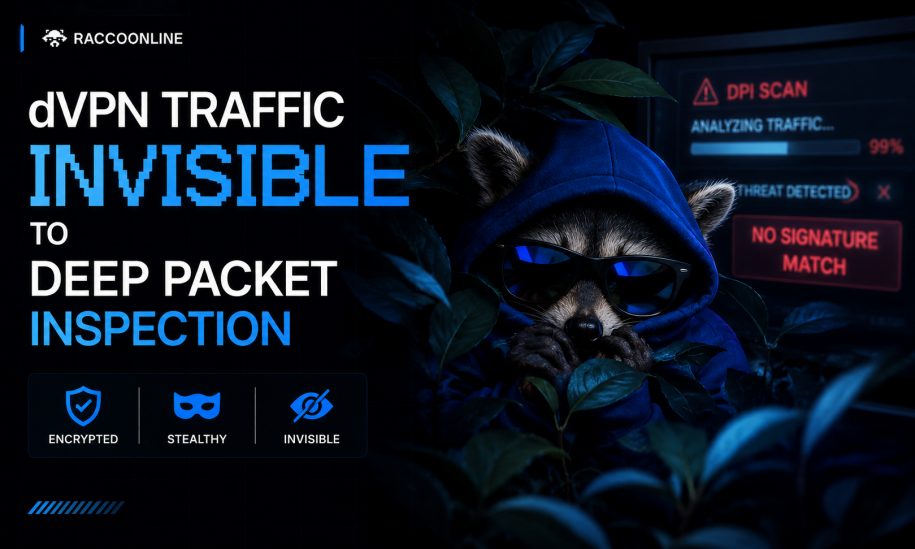
RaccoonLine, a decentralized VPN built on VLESS protocol and peer-to-peer node infrastructure, today published technical documentation on Wandering Flow, its proprietary dynamic routing mechanism, explaining how path-switching reduces reliance on the fixed-endpoint vulnerability that limits VLESS-only deployments in high-censorship environments.
Protocol choice gets most of the attention in discussions about VPN censorship resistance. VLESS vs WireGuard, TLS wrapping vs raw UDP these are real differences that matter.
But protocol alone is not enough. A VLESS connection to a fixed server IP is identifiable over time through traffic-pattern analysis, even if the packet contents cannot be read. The server IP gets flagged. The connection timing becomes a signal. The route becomes predictable.
Wandering Flow routing addresses this. It is the mechanism RaccoonLine uses on top of VLESS, and it changes how traffic analysis works against dVPN connections.
The Problem Protocol Alone Does Not Solve
Modern censorship systems in China, Iran, and other Tier 3 environments use two distinct detection methods. The first is protocol fingerprinting – reading the shape of individual packets to identify VPN traffic. VLESS handles this: its traffic is indistinguishable from HTTPS at the packet level.
The second method is traffic-pattern analysis. Even when individual packets cannot be identified, a connection to the same IP address at regular intervals, with consistent data volumes and timing, can be flagged as suspicious. The content is opaque, but the behavior is not.
A fixed-endpoint VPN even running VLESS creates a predictable pattern. The user connects to server X. Traffic flows between the user and server X for the duration of the session. Server X’s IP accumulates enough suspicious signals that it gets added to a blocklist.
This is why IP rotation and CDN integration became standard recommendations for VLESS deployments. But rotation requires infrastructure management, and CDN integration has its own limitations.
What Wandering Flow Does
Wandering Flow is a dynamic path-switching mechanism built into RaccoonLine’s architecture. Rather than establishing a session between a user device and a fixed exit node, it continuously cycles traffic through different nodes in the P2P network.
The effect on traffic-pattern analysis is direct. There is less reliance on a single persistent connection to a single IP address for analysis systems to flag. The traffic does not accumulate at one point long enough to generate a suspicious behavioral signature. Each segment of a session may pass through different nodes, with different IPs, at different times.
From the perspective of a DPI system trying to build a behavioral profile: the traffic looks like HTTPS, it goes to different destinations, and the pattern changes continuously. There is reduced stability in observable patterns that can be used for long-term profiling.
The Role of P2P Node IPs
Standard VPN servers run on data center IP ranges – AWS, DigitalOcean, Hetzner, OVH. These ranges are publicly documented and are among the first entries on censorship blocklists. A new VPN server on a data center IP may be blocked within hours simply because of the IP range, before any traffic analysis is done.
RaccoonLine’s network runs on residential P2P node IPs addresses belonging to individual operators running the node software on ordinary internet connections. These IPs are not associated with data centers. They are not in blocklist databases. Blocking them requires identifying individual connections, not ranges.
The combination of Wandering Flow path-switching and residential node IPs means that both detection methods censorship systems rely on. Protocol fingerprinting and IP-based blocking — are addressed at the architecture level.
What This Looks Like in Practice
For users in unrestricted environments, Wandering Flow is mostly invisible. The connection works, traffic is private, and the routing mechanics run in the background.
For users in countries running active DPI — China, Iran, Turkey the difference is whether the connection works at all after the first few days. Fixed-endpoint VLESS servers get flagged over time. Wandering Flow eliminates the fixed endpoint, which eliminates the primary signal those systems use for behavioral flagging.
It is not a guarantee of permanent undetectability. Censorship technology evolves. But it addresses the specific failure mode that takes down most VPN deployments in high-censorship environments: the accumulation of behavioral signals at a fixed server IP.
About RaccoonLine
RaccoonLine developed Wandering Flow routing to address a gap that VLESS alone does not close: fixed-endpoint behavioral fingerprinting. The mechanism continuously cycles traffic through different P2P nodes, preventing the accumulation of behavioral signals at a single IP that eventually flags fixed-endpoint servers in censored environments. Combined with VLESS protocol obfuscation and residential node IPs, Wandering Flow is the core of RaccoonLine’s censorship resistance architecture.
More information available at: raccoonline.com